

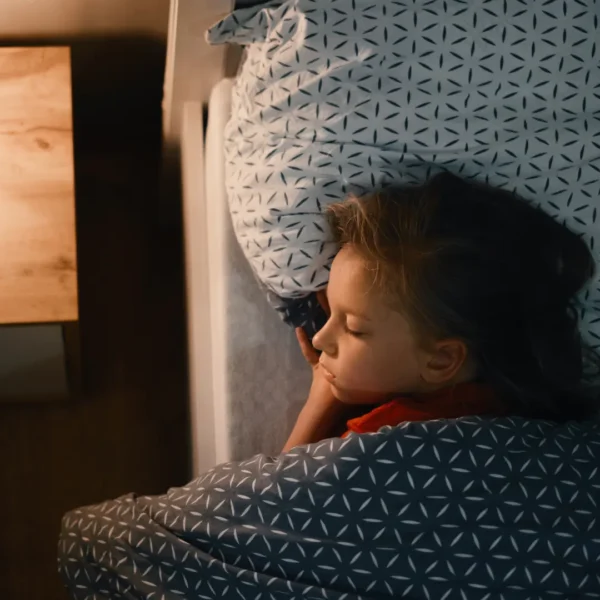
If bedtime feels like it’s harder than it should be, you’re not imagining it.
Many parents tell me their child does “pretty well” all day long… and then bedtime hits. Suddenly there are tears, stalling, clinginess, and big emotions that seem to come out of nowhere.
So let’s better understand what’s happening.
At its core, bedtime is a separation.
And with separation comes feelings of loss, aloneness, and worry. Yes, even if you’re just in the other room. Even if bedtime has always looked the same. Even if your child knows you’ll be there in the morning.
To a child, separation isn’t measured in logic, it’s measured in felt experience. And when the lights go off and you leave the room, your child is being asked to let go of:
- Your physical presence
- Your voice
- The sense of immediate connection and safety they feel when you are with them
That can feel quite big inside their body.
When Kids Don’t Have Words, They Use Behavior
Your child most likely doesn’t have the language or emotional understanding to say: “I feel anxious about being alone.” “This transition feels hard for my nervous system.” “I need reassurance that you’re still here.”
So instead, you get:
- “One more book!”
- “One more hug!”
- “I’m thirsty.”
- “I’m hungry.”
- “Wait! I forgot something.”
Anything to keep you there just a little longer.
What looks like stalling or manipulation is often connection-seeking. What looks like defiance is often separation anxiety.
Clinginess, repeated requests, and difficulty settling are common ways children try to manage that internal discomfort.
A Powerful Reframe: Goodnight Is Not Goodbye
Here’s one meaningful idea you can use with your child: Help them understand that goodnight is not the same as goodbye.
For many kids, saying goodnight feels like goodbye – like you’re gone and they’re all alone. Even if they intellectually know this isn’t true, this is how they feel.
That’s why clearly naming the distinction between goodnight and goodbye can be incredibly grounding.
You might say something like:
“When we say goodnight, I wonder if it sometimes feels like goodbye.
Like I’m gone and you’re all alone?
I’m not gone, sweetie. At night, I’m still here.
You close your eyes and can’t see me, I know. But you can hear me sometimes, right?
Sometimes I’m washing the dishes… sometimes I’m talking to daddy/mommy in the other room.
Even when you can’t see me, you know I’m still here.”
And then expand:
“And when you can’t see me, you can still think about me in your mind anytime you want.
And feel me in your heart anytime you want.
We say goodnight when it’s time for sleep.
Not goodbye, just goodnight.”
Help your child build the understanding that connection still exists, even when they can’t see you.
You’re not trying to eliminate bedtime emotions. You’re helping your child move through them with support and reassurance.
I know how much sleep struggles can affect a home. When your child resists bedtime, night after night, it doesn’t just impact their rest. It affects your evening, your patience, your relationship.
That’s why I created an extensive sleep section inside my Everything 3–7 Course. To guide you step-by-step through the emotional, behavioral, and developmental layers of sleep and answer all the many sleep questions parents always ask me.
You learn how to:
✅ Understand the emotional roots of bedtime resistance
✅ Respond to stalling, hyperactivity, and meltdowns without panic or punishment
✅ Handle “one more hug,” “I’m thirsty,” and all the classic bedtime tactics
✅ Support your child through nighttime fears and separation anxiety
✅ Create calm, connected bedtime routines that actually stick
✅ Set firm but loving boundaries around bedtime
✅ Respond to middle-of-the-night wakeups
✅ Transition your child from your bed to theirs
✅ Teach your child emotional safety around sleep, not fear or pressure
Whether your child is resisting bedtime, waking up multiple times, or struggling with transitions at night, you’ll find real-life tools to support them – without traditional sleep training, shame, or forcing.
If bedtime has become a battle in your home, I want you to know it can get better.
✨ Join the Everything 3–7 Course and get the full Sleep Section (plus so much more). Let’s bring more peace to your nights.
 The #1 Sleep Hack Most Parents Overlook
 The 6 Parenting Principles That Will Transform Your Parenting Journey