
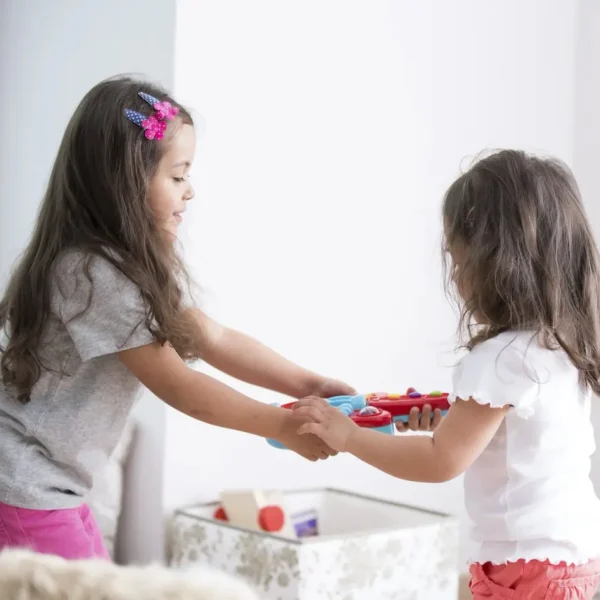
Your kids are fighting again.
This time, it’s about a blue plate. Or the middle seat in the car. Or who gets to sit next to you at dinner. Or who gets to shower first…
And in the moment, it sort of feels absurd, right?
It’s just a plate.
It’s just a seat.
Just take a shower! What’s the big deal?
But here’s the truth that often changes everything for the families I work with: So often, the fight is not about the object. It’s about the feeling underneath.
This reframe is a powerful shift because once you learn to stop reacting to the surface of the fight and start addressing the deeper emotion behind it, everything changes. You stop feeling like you’re putting out the same fire over and over again. And your children feel more understood.
The Iceberg Analogy: What You See vs. What’s Actually There
Think of your children’s conflicts as an iceberg.
- Above the waterline is the thing they’re fighting about: the toy, the cookie, the seat, the shirt.
- Below the waterline is the real reason they’re fighting: a feeling or a need.
And just like a real iceberg, what’s beneath the surface is far bigger, heavier, and more powerful than what you can immediately see.
When we respond only to the surface “thing” they’re fighting about, we often end up missing the heart of the matter. And because those deeper needs go unaddressed, the conflicts keep repeating.
What Are They Really Fighting About?
Here are just a few of the deeper needs and feelings that often drive sibling conflict:
- A need for connection
“Who gets to sit next to mom?” might actually be: I want reassurance of your love and our connection. - A need for power or control
“That’s MY toy!” might really be: I want to feel powerful and in charge of something. - A feeling of inferiority
“Why does he always get to go first?” might actually mean: I feel less important than my sibling. - Jealousy or competition
“Why does she get a bigger piece?” might stem from: I sometimes feel I matter less. - Boredom and overstimulation
Random teasing or picking fights could signal: I need stimulation, attention, or emotional release.
Children mostly don’t have the self-awareness or vocabulary to understand and express these emotions directly. Instead, they express them through objects, moments, and interactions that look simple (and even petty) on the surface, but carry real weight beneath.
What Happens When You Only Focus on the Object?
Let’s imagine two kids are fighting over a toy.
You step in and say: “Just take turns!”
Or: “You know what? No one gets the toy!”
This might stop the fight temporarily, but because the emotional need that caused the fight hasn’t been acknowledged, it just bubbles up again, over something else.
You’ll find yourself stuck in the same cycle:
Blue plate → seat in the car → who holds the doll → which show to watch → who gets the “special” fork…
Unless the deeper need is validated and addressed, the objects may change, but the conflict keeps repeating.
So What Can You Do Instead?
Here’s how to respond in a new way, starting today:
- Pause Before Reacting
When a fight erupts, take a moment to check in with yourself and ask: “What might this really be about?”
Your grounded curiosity helps you shift from reacting to investigating.
- Acknowledge the Feeling, Not Just the Object
Instead of saying, “Stop fighting over the toy. You’re too big for that now, anyway.” you can say:
“You’re upset your little brother is playing with your toy. I get it, it’s yours.”
- Address Both Equally
Help both children feel seen:
“Even when he’s playing with it, it’s still yours.”
“How about you ask your big brother: Can I play with that?”
Final Thoughts
If you’ve ever felt like your kids are constantly fighting about nothing, I hope this comes as a bit of relief:
It’s never really about nothing.
It’s about something real and often hidden: a feeling, a need, wanting connection, longing for power, sense of identity, place in the family, a voice that wants to be heard. And once you begin to see beneath the surface, everything becomes clearer.
You’ll start to feel less like a referee and more like a guide. Less reactive, more reflective. Less focused on the object and more attuned to what your child is really asking for.
In my Everything Siblings Course, I teach you exactly how to develop this “X-ray vision”. The ability to see beyond the surface of sibling conflict and respond to the real emotional need underneath. You’ll learn how to stay calm, guide with confidence, and build a sibling dynamic rooted in connection, not rivalry.
If you’re ready to stop just breaking up fights and start building skills that last a lifetime, click here to learn more.
 The 5 Principles That Will Change How You Handle Sibling Conflict
 How to Not Take Sides When Siblings Fight: A Guide for Parents