
They’re Changing. And Your Parenting Is, Too.
They want more independence, more privacy, and more say, but they still need your guidance and support. Just in new ways.
You’re dealing with back-talk, screen battles, friendship drama, and constant negotiations.
And now come the bigger questions: Puberty. Social pressure. Online safety. Confidence. Independence.
You want to give them room to grow, but you don’t want to lose your authority or connection.
The good news? This stage doesn’t have to be one long power struggle.

The Relationship You Want Tomorrow Starts With How You Parent Today.
You don’t have to choose between being the parent and being the person your child comes to.
Learn how to handle the back-talk, reduce the constant negotiating, build responsibility, and navigate the bigger conversations.
All while staying connected to the child who’s growing up right before your eyes.
Less arguing. More cooperation. Stronger connection.
Every Part of These Years, Covered
Be the parent who feels safe to come to with the hard stuff, not just the easy stuff.
- Cooperation Without Yelling
- Responsibility Without Nagging
- Understand How Your Child Thinks


- Back-talk and Attitude
- Discipline
- Screen Time Battles
- Body Image
- Puberty
- Phones and Social Media
- Friendship Drama
- Social Skills


- Confidence and Self-Talk
- Insecurity and Comparison
- Homework Struggles
Learn Your Way
No schedule to keep, no order to follow, no falling behind.

Watch Or Listen Anywhere

Cheat Sheets for Easy Reference

Tangible Results in Real Time
You're on the Same Team
Lead without trying to control.
- Homework gets done without you hovering
- “Try that again” replaces “Don’t talk to me like that!”
- They pack their own backpack because you stopped doing it for them
- They tell you what happened at lunch, even the embarrassing part
- When something online confuses them, they come to you first
When you stop repeating, lecturing, and taking the bait, you get to be what your child actually needs: the steady one.

Your Full Course Breakdown
- 11 in-depth course sections broken into short, topic-based segments
- Downloadable audio files for on-the-go listening
- 14 printable cheat sheets and toolkits
- Word-for-word scripts for the hard talks: back talk, puberty, body image, sex, phones, and what they see online
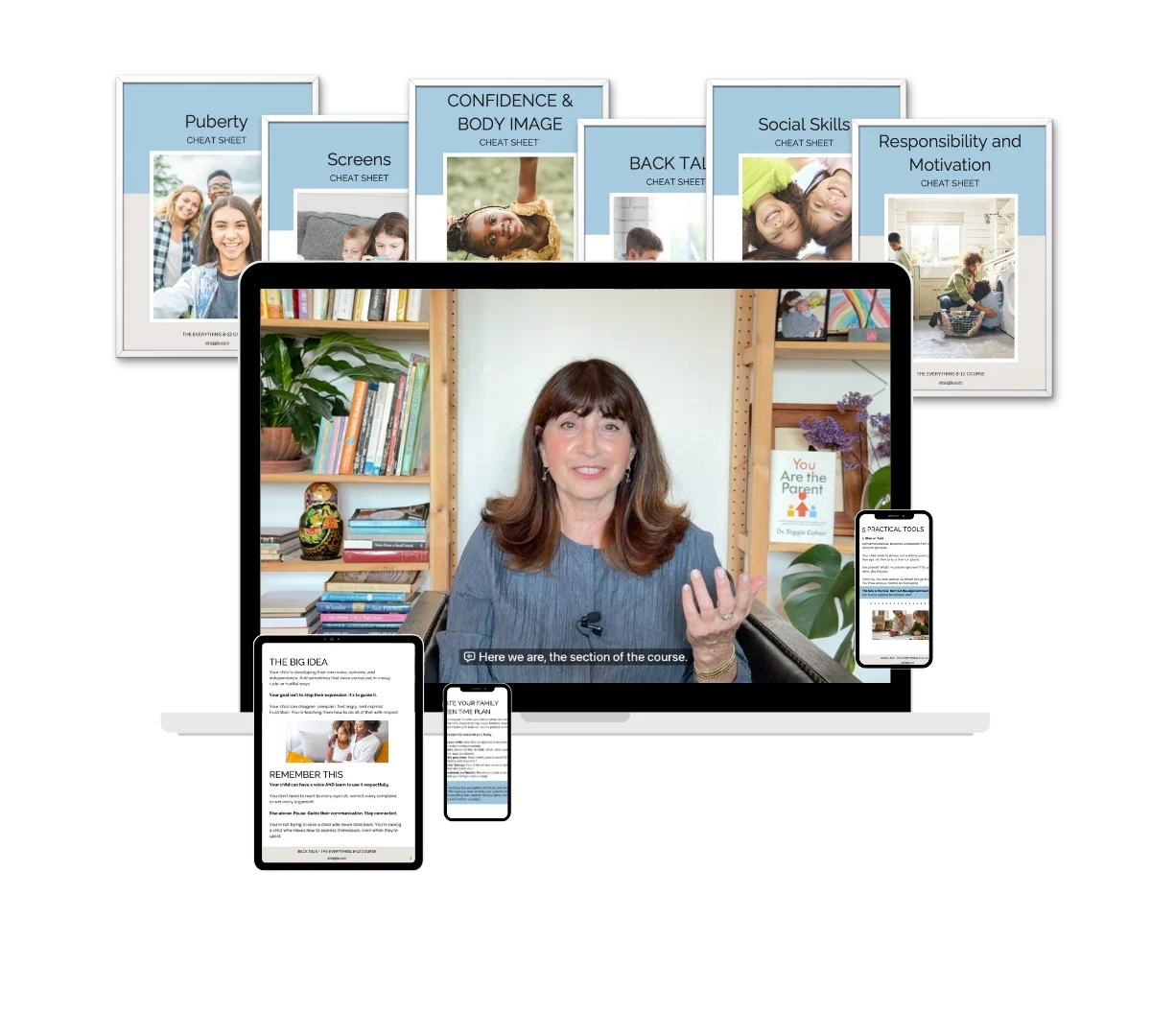
Here’s a Look Into the Course
These Years Can Feel Lonely for Parents, Too.
They tell you less. Their friends matter more. Some days you want to hold on tight, and other days you know you need to let go a little.
Your child still needs you, just in new ways. This course shows you what those ways are, with scripts and tools you can use in the moments that catch you off guard.
11 Sections. One Steady Plan for These Years.
Short lessons built for real life, with scripts you can use the same day.
Section 1: How Your Child Thinks Now
Understand the four big shifts of this age: more complex thinking, a perspective that hasn't caught up, constant comparison, and a growing private world.
When you know what's driving the behavior, your expectations get realistic and staying calm gets easier.
Section 2: Responsibility and Motivation
Build a family chore plan your child helps create, break the nag-repeat-yell cycle, and let go of doing it all yourself.
Grow the motivation that comes from inside, plus a simple spend, save, and share approach to allowance.
Section 3: Screens, Phones, and Social Media
Six mindset shifts that take the fear out of screens, then a family screen plan that holds up at shut-off time.
Decide on a first phone with confidence, and prepare your child for comparison, online friendships, and inappropriate content.
Section 4: Puberty
Puberty is starting earlier and lasting longer than most parents expect. Get calm, clear scripts for body changes, periods, erections and wet dreams, and sex.
Learn the difference between privacy and secrecy, and how to stay the person your child brings their questions to.
Section 5: Confidence and Insecurity
What to say when your child says "I'm ugly" or "I'm stupid," without pitying, dismissing, or overselling.
Build balanced thinking, a healthy view of mistakes, a grounded body image, and coping skills your child can actually use.
Section 6: Listening and Cooperation
17 tools for the stalling, the “in a minute,” and the requests you’ve already made five times.
Stop repeating yourself, skip the power struggle, and get cooperation that doesn’t depend on yelling.
Section 7: Back-talk
9 tools for the eye rolls, the attitude, and the “You can’t make me.”
Respond calmly instead of taking the bait, and guide your child’s voice instead of shutting it down.
Section 8: Discipline That Teaches
Why punishments stop working, how rewards differ from incentives, and how to let natural consequences do the teaching.
Set boundaries that hold without threats or lectures, and know what to do if outbursts keep happening at home.
Section 9: Friendships and Social Skills
Teach your child to reach out, disagree respectfully, compromise, and repair after a fight.
Navigate bragging, bossiness, teasing, gossip, friendship drama, and how to tell real bullying from a hard day.
Section 10: Homework
Validate the "I don't want to" without giving in, and hand over ownership so you stop managing every assignment.
Know when homework struggles are a signal to bring in the teacher.
Section 11: Repair and Balance
For the days you lose it anyway. Learn to apologize without blame, find your own triggers, and move forward without guilt taking over.
Download: The General Reflection Toolkit
Everyday conversations are powerful opportunities to shape how your child thinks about themselves, others, and the world around them.
This guide shows you how to use ordinary, calm moments to encourage reflection, expand perspective, and build self-awareness.
Download: The Back-Talk Toolkit
When your child speaks disrespectfully, your instinct may be to immediately correct their tone.
This guide offers alternative responses that help you address inappropriate communication without escalating the situation, while teaching your child more respectful ways to express themselves.
Download: The Pushback Toolkit
A practical guide to navigating the most common forms of resistance, from arguing and negotiating to refusing and complaining.
Learn exactly what to say in these everyday moments so you can stay calm, hold your boundaries, and avoid getting pulled into unnecessary power struggles.
Download: Calm Parent Blueprint
Every parent has moments when staying calm feels impossible.
Discover the 5-step method that helps you pause, reset, and respond with more patience, even when emotions run high.
Download: Cheat Sheets
9 additional PDFs to support you on your journey
1-Year Money-Back Guarantee!
Change the dynamic in your home risk-free and at your own pace with our 1-year money-back guarantee.
I stand wholeheartedly behind this work because I’ve seen it shift the dynamic in thousands of homes. I want you to feel completely at ease starting this journey. Change the dynamic in your home at your own pace; if you are not satisfied with the results, I am more than happy to provide a full refund within one year of your purchase.
Common Questions
What’s the format of the course?
The course is made up of videos, downloadable audio files, and downloadable PDFs. Watch from any device, download and listen on the go, or read the content - whatever works best for you.
Each video is precise, straightforward and PACKED with tools, scripts and real-life examples. I know you have a lot going on so I kept each video very digestible and full of useful info you can begin to use immediately in your home.
In addition, each section of the course has an accompanying downloadable “cheat sheet” that you can print out and keep on hand for easy reference to all your scripts and tools. These are like your “notes” to have ready and accessible any time you need.
How long will I have access to the course after I purchase it?
You’ll get lifetime access, including all future updates.
What makes your course different from other courses?
It won't hand you a rulebook or a reward chart. It explains what's happening in your child's development at this age, then gives you the exact words for the hard moment and the calm conversation afterward.
What age is this course for?
It's built for children ages 8 to 12. Most of the tools carry right into the teen years, and they support you as much as your child.
I've been yelling and taking things away for years. Can I really change the pattern?
Yes. Patterns are learned, and they can be reset. The course walks you through how to name the pattern with your child, make a new plan together, and repair on the days it doesn't go well.
Do I watch the puberty section with my child?
No, the course is for you. You'll get simple, factual scripts you can use in short, casual conversations, and you decide how much detail fits your child and your family's values.
We're not ready to give our child a phone. Is the screens section still relevant?
Absolutely. It covers TV, gaming, and YouTube, how to build a family screen plan, and how to say "not yet" to a phone and hold it when the pushback comes.
My child is fine at school but falls apart at home. Is that normal?
It's very common, and it's useful information. It tells you your child has the skills to regulate. The course helps you spot the pattern at home and change it, and explains when struggles across every setting call for extra support.
Will this help with a strong-willed child?
Yes. The course shows you how to recognize your child's temperament, whether feisty, flexible, or fearful, and how to guide each one. For a strong-willed child, that means helping them use their strength without overpowering everyone around them.
When should we get extra support?
If your child seems persistently withdrawn or sad, has big outbursts in every setting, or has worries about their body that are affecting daily life, reach out to a mental health professional. The course flags these moments so you know the difference.
What if I don't have time to take a full course right now?
The lessons are short and topic-based, with audio you can listen to in the car or on a walk. Start with the section that fits what's happening in your home this week.
Who is the course for?
Parents, caregivers, grandparents, and anyone raising or supporting a child ages 8 to 12. Taking it alongside a co-parent makes it easier to stay consistent.
What if the course doesn't work for me?
I stand wholeheartedly behind my work. If you are not satisfied with the course, I’m more than happy to provide a full refund within 1 year of purchase. Send an email to contact@drsiggie.com.